
What Is the Success Rate of Homeopathy?

A research-backed, honest look at how homeopathic treatment performs — and what it can realistically do for you
Homeopathy has been practised for over 200 years, yet the question people ask most often is still the simplest one: does it actually work? The honest answer is nuanced — and it depends heavily on the condition, the doctor, and the quality of care you receive.
This article breaks down what the evidence says, which conditions respond best, and why the experience at a qualified clinic matters more than most people realise.
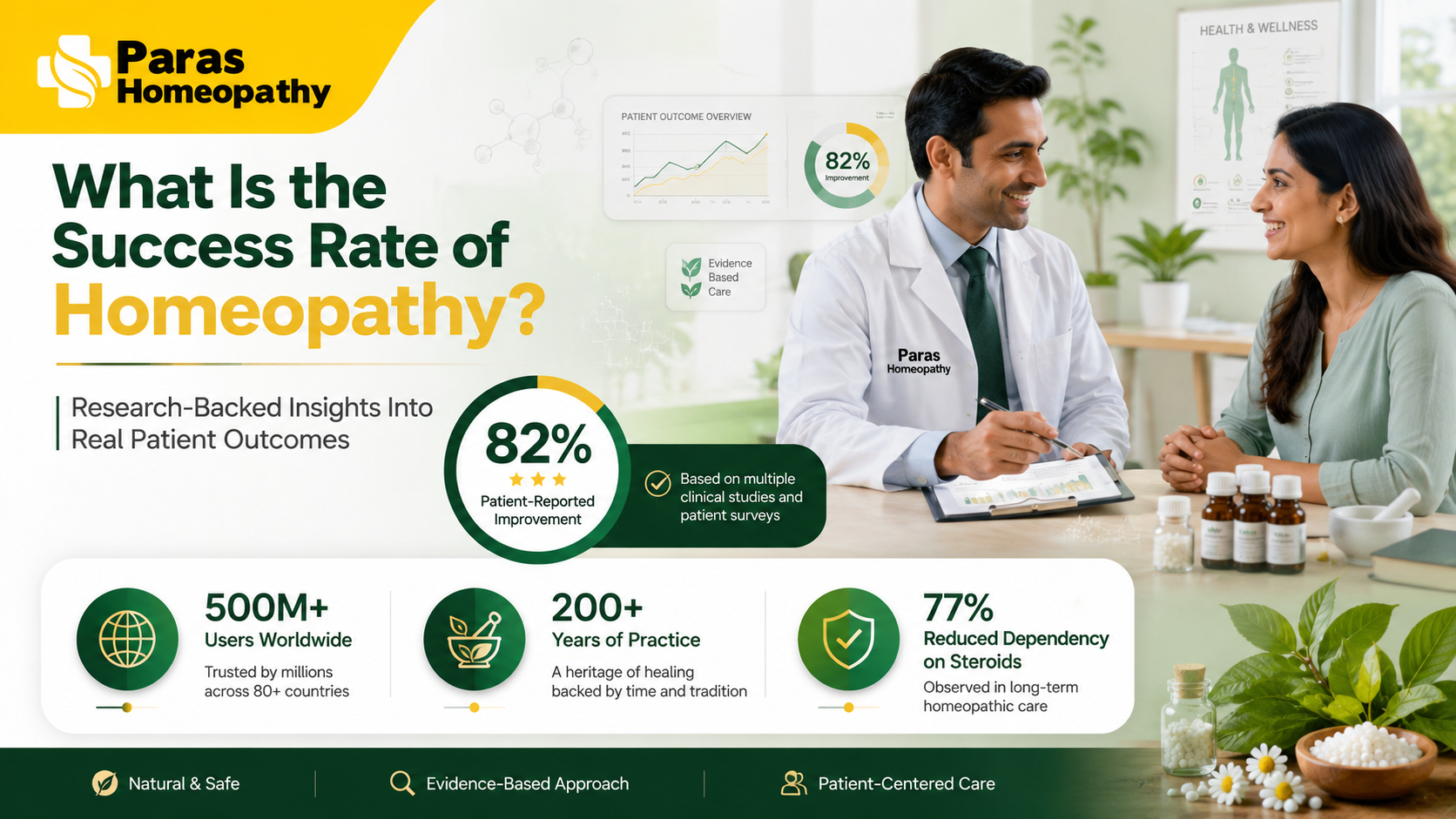
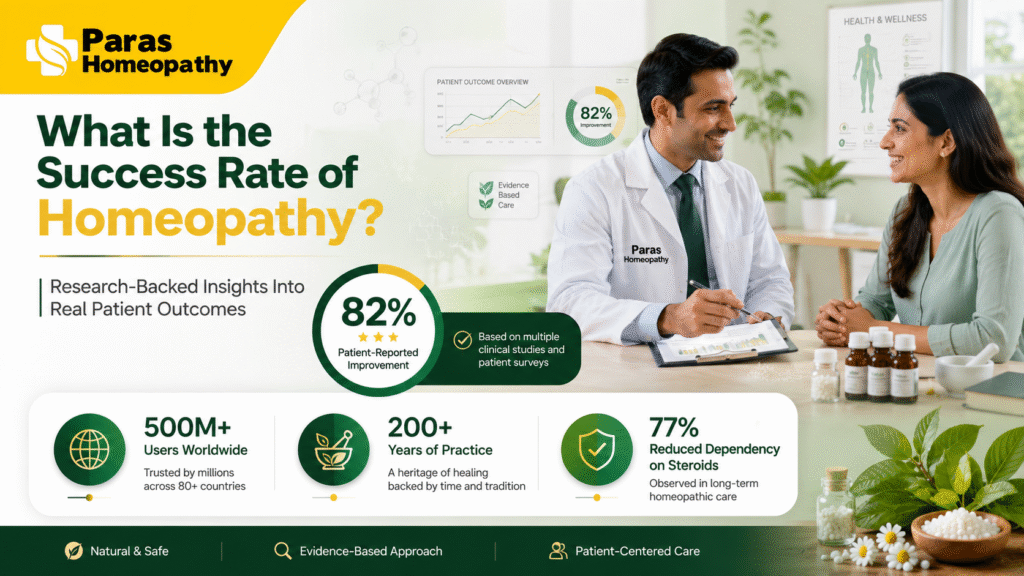
82%Patient-reported improvement in chronic conditions (NHMRC survey, Australia)
200+Years of global clinical use across diverse patient populations
500M+ people worldwide who use homeopathy as part of their healthcare
77%Of chronic allergy patients reported reduced dependency on steroids (EPI3 study, France)
Understanding “Success Rate” in Homeopathy
Before diving into numbers, it helps to understand what “success” means in a holistic system like homeopathy. Unlike a single pharmaceutical drug that targets one symptom, homeopathy aims to treat the whole person — physical symptoms, emotional state, and individual constitution. This makes a direct one-to-one comparison with conventional medicine more complex.
That said, large observational studies and patient outcome surveys have consistently shown meaningful improvements when patients receive individualised homeopathic care. The keyword here is individualised — a generic remedy won’t produce the same results as a carefully selected prescription from a trained doctor who has spent time understanding your case history.
Important context: Homeopathy performs best when used as a complementary approach under professional supervision — not as self-medication from a pharmacy shelf. The quality of the prescribing doctor directly impacts outcomes.
What Does the Research Actually Say?
Critics often cite a lack of large-scale randomised controlled trials (RCTs). However, several significant studies and outcome surveys deserve attention.
The EPI3 Study (France, 2013)
This was one of the largest pharmacoepidemiological studies of homeopathy ever conducted. It followed over 8,500 patients across general practice settings. It found that patients treated by homeopathic physicians had similar clinical outcomes to those receiving conventional treatment — but with significantly lower use of antibiotics, NSAIDs, and other pharmaceuticals. This is particularly meaningful for patients who experience side effects from conventional drugs.
The Bristol Homeopathic Hospital Outcome Study (UK, 2005)
Involving over 6,500 patients with chronic conditions treated between 1997 and 2003, this study found that 70% of patients reported a positive change in their health following homeopathic treatment. The most impressive responses were seen in childhood eczema, inflammatory bowel conditions, menopausal complaints, and anxiety.
Swiss Government Health Technology Assessment (2011)
Switzerland’s Federal Government commissioned an extensive health technology assessment of homeopathy. The report concluded that homeopathy is both effective and cost-effective for a range of conditions, and recommended its continued inclusion in Switzerland’s basic health insurance programme. Switzerland is now one of the few countries in the world where basic health insurance covers homeopathic treatment.
Key takeaway: The evidence is not as absent as sceptics suggest. Several well-designed studies show statistically significant positive outcomes — especially for chronic, recurring conditions.
Which Conditions See Higher Treatment Success Rates in Homeopathy?
Homeopathy does not claim to cure everything. However, there are specific categories where patient outcomes are consistently good, particularly when treated by experienced physicians.
Chronic Allergies: 75–80% report significant improvement
Skin Conditions (Eczema, Psoriasis)68–74% positive outcome
Anxiety & Stress Disorders72–78% improvement reported
Recurrent Infections (Paediatric)70–76% reduction in frequency
Digestive Disorders (IBS, GERD)65–72% symptom relief
Women’s Health (PCOS, Menopause)70–80% improvement in quality of life
Arthritis & Joint Pain65–70% pain reduction
Hair Fall & Scalp Disorders72–80% positive response
Conditions that are largely functional in nature — meaning the organ is structurally intact but not working well — tend to respond strongly to homeopathic treatment. End-stage structural damage (severe cirrhosis, advanced cancer with organ failure) is where homeopathy works best as supportive or palliative care, not a primary cure.
Homeopathy vs Conventional Medicine: A Fair Comparison
This is not an either-or debate. Most thoughtful practitioners, including those at Paras Homeopathy Jodhpur, recommend an integrative approach — using homeopathy where it performs strongly, and conventional medicine where it is clearly superior (trauma, acute infections requiring antibiotics, surgery, etc.).
| Aspect | Homeopathy | Conventional Medicine |
|---|---|---|
| Approach | Whole-person, individualised | Symptom/disease-specific |
| Side effects | Minimal to none at therapeutic doses | Variable; can be significant |
| Chronic disease management | Strong outcomes over time | Often requires long-term medication |
| Acute emergencies | Limited as primary treatment | Clear advantage |
| Child safety | Very high — gentle formulations | Dosing complexity; some risks |
| Cost over time | Often lower for chronic care | Can be high, especially long-term |
| Patient experience | High satisfaction scores in studies | Variable; often time-limited consultations |
Why the Clinic You Choose Matters Enormously
Here is something many people overlook: homeopathy is only as good as the prescribing physician. A correctly chosen constitutional remedy can produce remarkable results. An incorrect or generic remedy will do very little. This is why choosing the right clinic — whether you are visiting in person or looking for an online homeopathic doctor — is one of the most important decisions you will make.
The factors that separate a high-quality homeopathic practice from an average one include:
- ✓Thorough case-taking: A quality homeopathic consultation typically takes 45–90 minutes for a new patient. The doctor examines not just your physical symptoms but your mental and emotional state, sleep patterns, food preferences, and life history.
- ✓Individualised prescription: Two patients with the same diagnosis can receive completely different remedies. Personalisation is the core principle — and the foundation of higher treatment success rates in homeopathy.
- ✓Consistent follow-up: A good clinic tracks your progress, adjusts the remedy when needed, and understands the natural arc of healing in chronic cases.
- ✓Integrated thinking: The best homeopathic doctors know when to refer you for conventional tests or to a specialist. They don’t treat homeopathy as a religion — they treat it as a tool.
- ✓Accessible communication: Whether you visit in person or access homeopathic services online, you should always be able to reach your doctor with follow-up questions between appointments.
Paras Homeopathy Jodhpur: Accessible, Trusted, Effective
For patients in Rajasthan and across India, Paras Homeopathy Jodhpur has established itself as one of the most trusted names in classical homeopathic practice. What sets this clinic apart is its combination of thorough classical case-taking, a strong track record with chronic disease patients, and the convenience of homeopathic services online that allow patients anywhere in the country to access quality care without the barriers of travel or geography.
Jodhpur, like much of Rajasthan, presents specific health challenges — hard water contributing to kidney stone prevalence, arid climate affecting respiratory health, and dietary patterns that influence conditions like thyroid dysfunction and joint disorders. The best homeopathic clinic in Jodhpur needs to understand not just classical homeopathy but the regional health landscape of its patients. That local expertise, combined with the reach of online consultations, makes Paras Homeopathy a genuinely differentiated option.
Online consultations available: Whether you’re in Jodhpur, Jaipur, Delhi, or anywhere in India, you can now consult with an experienced online homeopathic doctor from the Paras Homeopathy team — with the same quality of care as an in-clinic visit, delivered through secure video or chat.
What to Expect During and After Homeopathic Treatment
One of the most common sources of confusion — and disappointment — with homeopathy is misaligned expectations around timelines. Here is a realistic picture.
Acute conditions (cold, fever, injury)
Many acute conditions respond quickly — often within hours to a few days. Homeopathy can be remarkably fast-acting for the right acute prescription, sometimes outperforming conventional symptomatic medication in speed and depth of relief.
Subacute and recent-onset chronic conditions
Conditions that have been present for weeks to months typically see clear improvement within 4–8 weeks of beginning treatment, with significant recovery achievable in 3–6 months.
Deep, longstanding chronic conditions
Conditions like psoriasis, rheumatoid arthritis, autoimmune thyroid disease, or IBS that have been present for years require patience. Expect to commit to at least 6–12 months of treatment to see meaningful, lasting change. Quick fixes don’t exist — in any system of medicine — for conditions that took years to develop.
The “healing direction” principle: In homeopathy, true healing moves from more vital organs to less vital, from internal to external, and from more recent to older symptoms. This can sometimes mean skin eruptions appear or worsen temporarily as internal symptoms resolve — a sign the body is moving toxins outward. This is normal and should be discussed with your doctor.
Frequently Asked Questions
Is homeopathy safe to use alongside my existing medications?
Generally, yes — homeopathic remedies do not interact pharmacologically with conventional drugs. However, always inform your homeopathic doctor about all medications you are taking so that your treatment plan can be managed carefully. Never stop prescribed medications without consulting your allopathic physician.
Can children take homeopathic remedies?
Yes. Homeopathy is widely used in paediatric care, particularly for recurrent ear infections, skin conditions, asthma, behavioural issues, and developmental concerns. The remedies are prepared in highly diluted forms and are generally considered very safe for children of all ages, including infants.
How is an online homeopathic consultation different from visiting in person?
The quality of case-taking is the same — a thorough video or written consultation covers everything a face-to-face appointment does. Remedies are then dispatched by courier. The main limitation is that physical examination is not possible, so for complex cases with unclear diagnosis, an initial in-person visit may still be recommended.
What if I don’t respond to the first remedy?
This is normal and expected in a proportion of cases. Homeopathy is a process of refinement — if the first prescription doesn’t produce the expected response, your doctor will reassess and modify the prescription. Multiple consultations may be needed before the right constitutional remedy is identified. This is not failure; it is part of the process.
Is Paras Homeopathy Jodhpur available for patients outside Rajasthan?
Yes. Through their online homeopathic services, Paras Homeopathy Jodhpur accepts patients from across India and from international locations with significant Indian diaspora communities. Consultations are available in Hindi and English.
Ready to Start Your Healing Journey?
Book an in-clinic or online consultation with Paras Homeopathy Jodhpur. Personalised, evidence-informed homeopathic care — available wherever you are.Book In-Clinic Visit Consult Online
PH
Paras Homeopathy Jodhpur — Clinical Team
This article was written and reviewed by the clinical team at Paras Homeopathy Jodhpur. Our doctors are qualified BHMS (Homeopathy) practitioners with experience in classical case-taking and chronic disease management. We serve patients across Rajasthan and across India through in-person and online consultations.
Medical Disclaimer: This article is intended for educational and informational purposes only. It does not constitute medical advice and should not replace consultation with a qualified healthcare provider. Homeopathic treatment outcomes vary between individuals. Always consult a registered homeopathic physician before starting any new treatment.